
Ximenez-Fatio House Museum — woman owned since 1830!
Built in 1798, original coquina house, by Andres Ximenez for he and his wife, a Minorcan, Juana Pellicer, and their children
Located at 20 Aviles Street, the circa 1798 historic house was purchased in 1830 by widow Mrs. Margaret Cook purchased the property and converted the home into a boarding house. Mrs. Sarah Petty Anderson, also a widow, purchased the boarding house from Mrs. Cook and lived in the house for over 15 years. In 1851, Miss Louisa Fatio became the manager of Mrs. Anderson’s boarding house. In 1855, Mrs. Anderson sold the property to Miss Fatio and moved to Tallahassee. Miss Fatio owned the property and kept it afloat during times of economic uncertainty, secession from the Union, re-occupation by Union troops in 1862, and Reconstruction. She died in 1875, having maintained the integrity, reputation, and prominence of this boarding house for almost 25 years. She also raised her nephew and nieces in the house. After Miss Fatio’s death, the house remained in her family until 1939. In that year, the National Society of Colonial Dames of America in the State of Florida purchased the property and began the decades-long process of meticulously restoring and furnishing the home with the intent of making it a historic house museum. As it was for almost 50 years, it operated as a boarding house; the home today is still owned and operated by women.
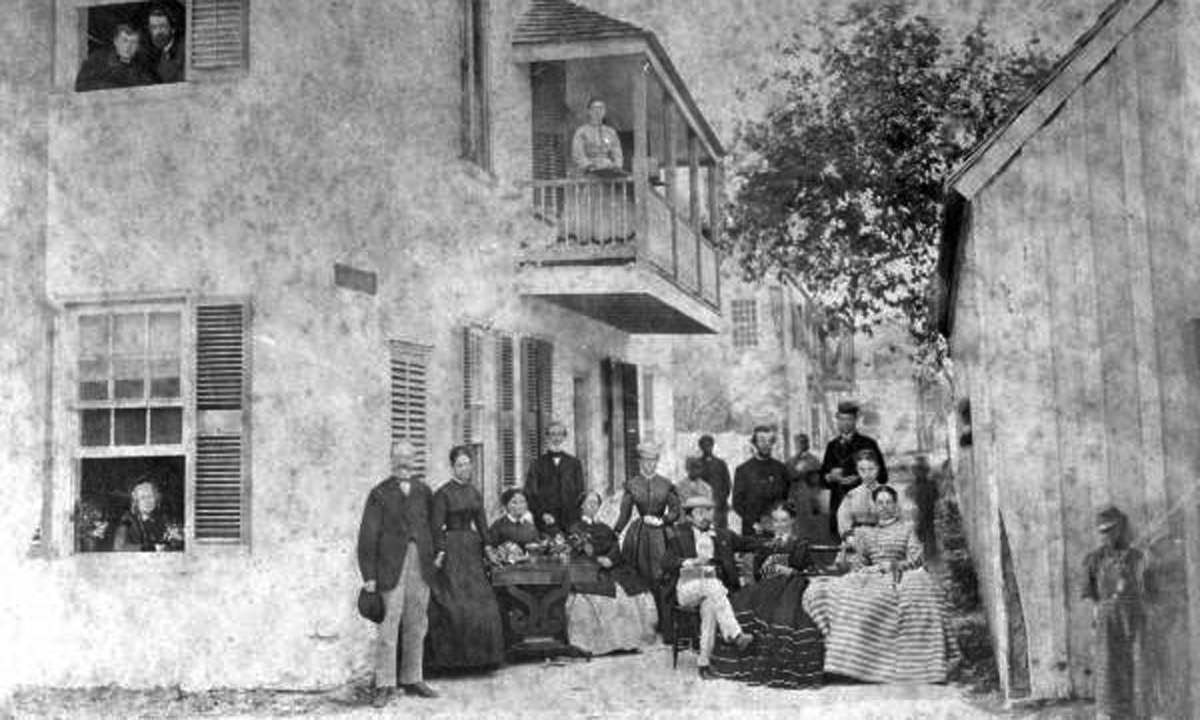
Louisa Fatio can be seen on the balcony in this historic photo. She owned the Ximenez-Fatio House from 1855-1875, but helped her aunt manage the house even before that time. This historic house was purchased from her family in 1939 by the National Society of Colonial Dames of America in the State of Florida. It is still operated by women today.
Peña-Peck House
Located at 143 St. George Street, the house was built around 1750 as a one-story coquina home, called the Old Spanish Treasury.
Originally constructed for Juan Estevan de Peña and his wife, Maria Antonia Adrisola, the house was their cherished home for 14 years. Their “love affair” with the property ended abruptly in 1763 when Spain ceded Florida to Great Britain in the Treaty of Paris. During the British occupation, the house gained prominence, hosting governors like John Moultrie and Patrick Tonyn.
In 1837, Dr. Seth Peck acquired the house, transforming it into a family residence and a hub of community life. Dr. Peck added a wooden second story to accommodate his growing family and established a medical office and general store on the ground floor.
The home remained in his family for 94 years, with his granddaughter, Anna Gardner Burt (also known as Miss Nannie), being the last family member to live there before gifting it to the city in 1931.
The Woman’s Exchange of St. Augustine, in partnership with the City of St. Augustine, maintain the house and grounds, offering audio tours, special exhibits, event rental space, and operate the longest running artist gift shop, with a mission of women supporting women. They give back to the community with college scholarships for women age 25+ and have funded more than $300K in tuition.
This month, the Woman’s Exchange has a Women’s History Month exhibit called Signed, Sealed and Remembered: Women on Postage Stamps. The exhibit is available during the complimentary house tours, Wednesday-Saturday, between 12-4;30 p.m.
St. Augustine Lighthouse – First Female Lighthouse Keeper in Florida
First Female Lighthouse Keeper In Florida — Maria Mestre de Los Dolores Andreu
She kept the light burning — Minorcan woman became Coast Guard trailblazer!
From a story in The St. Augustine Record: Maria Andreu of St. Augustine became the first Hispanic American woman ever to serve in the U.S. Coast Guard, decades before women could vote and many years before they joined the workforce. The Minorcan, known as Maria Mestre de los Dolores before her marriage to Joseph Andreu, became the St. Augustine Lighthouse keeper in 1859. She remained the lighthouse keeper through 1862. That’s the year the light was extinguished in preparation for the Civil War. She assumed the job when her husband fell to his death white washing the lighthouse.
“Monday last … (Joseph Andreu) was engaged in white washing the tower of the Light House when the scaffold gave way and he fell 60 feet, dying almost instantly,” the St. Augustine Examiner reported on Dec. 10, 1859.
📸: Photo from the St. Augustine Lighthouse archives, taken in the 1860s. The Spanish Watchtower became St. Augustine’s first lighthouse. This tower finally fell into the ocean in 1880. It had been crumbling for many years. The second lighthouse (the current St. Augustine Lighthouse) was built from 1871-74.